
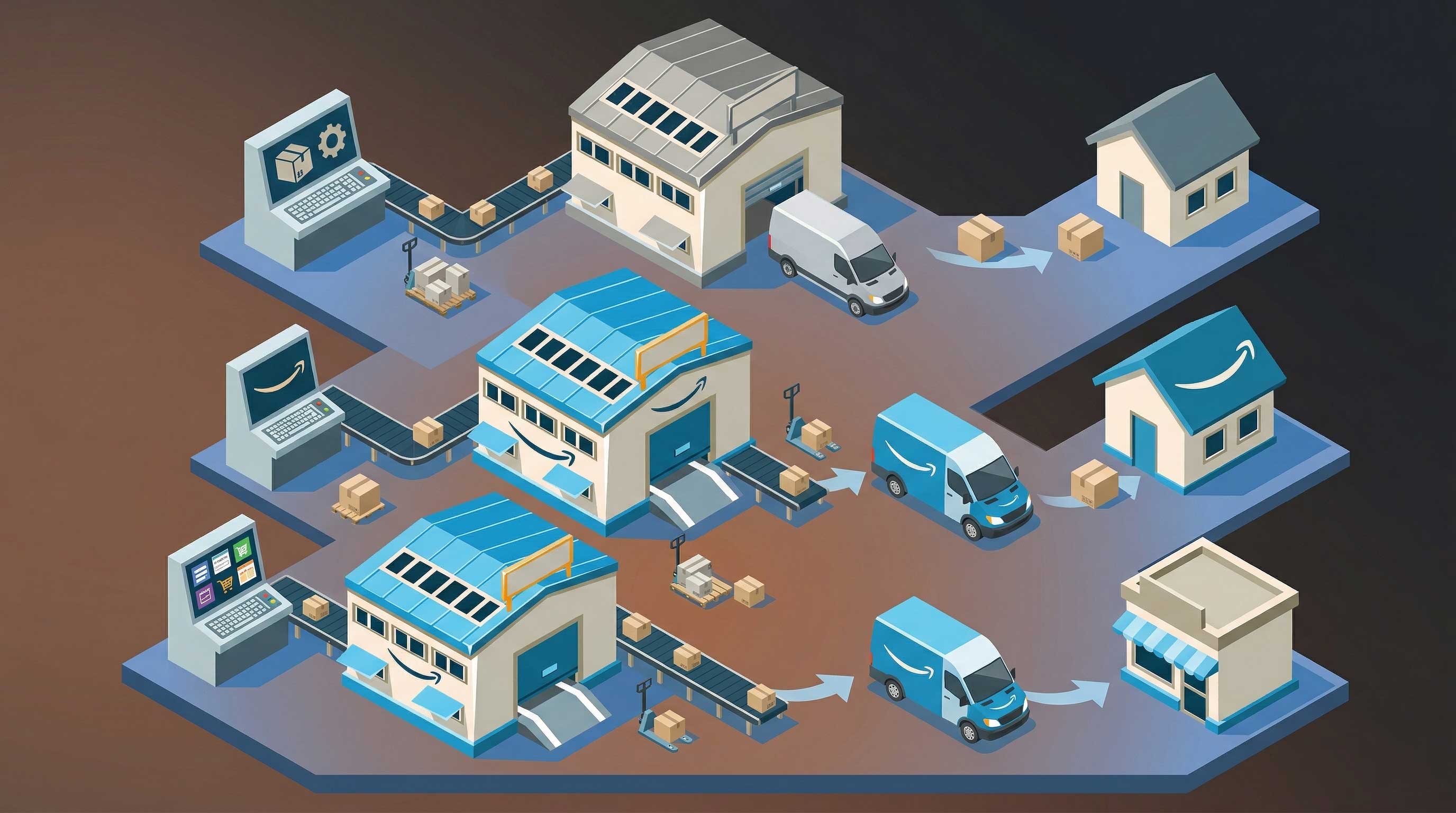


Understanding the Three Fulfilment Models
Before comparing them, it’s important to understand what each option actually does, and more importantly, what it doesn’t.
What Is a 3PL?
A third-party logistics provider (3PL) is an external partner that handles:
- Inventory storage
- Order picking and packing
- Shipping and returns
3PLs are commonly used by growing ecommerce brands that have outgrown in-house fulfilment but want flexibility across multiple sales channels.
However, most 3PL relationships involve:
- Custom pricing models
- Contracts or minimums
- Operational onboarding time
This makes them powerful, but not always simple.
What Is Amazon FBA?
Fulfilment by Amazon (FBA) allows sellers to send inventory into Amazon’s warehouse network. Amazon then:
- Stores products
- Ships orders
- Handles customer service (for Amazon orders)
The key limitation is this:
FBA is designed only for Amazon marketplace orders.
What Is Amazon MCF?
Amazon Multi-Channel Fulfilment (MCF) extends the FBA infrastructure to non-Amazon channels.
That means you can:
- Sell via Webflow, WooCommerce, Shopify, or other platforms
- Store inventory with Amazon
- Let Amazon fulfil all orders regardless of channel
This creates a unified logistics system powered by Amazon’s network.
Direct Comparison: 3PL vs FBA vs MCF
Channel Flexibility
- 3PL: Works across all channels
- FBA: Amazon-only
- MCF: Multi-channel support
MCF effectively combines the flexibility of a 3PL with Amazon’s infrastructure.
Cost Structure
3PL pricing is often fragmented:
- Storage fees
- Pick & pack fees
- Shipping costs
- Account management fees
FBA and MCF, by contrast, offer more structured pricing, though MCF can become expensive depending on order size and speed.
Delivery Speed
- 3PL: Depends on provider and warehouse locations
- FBA: Prime-speed delivery
- MCF: Fast (typically 1–3 days), but without Prime branding
Amazon’s logistics advantage is difficult for most 3PLs to match consistently.
Operational Complexity
3PLs often require:
- Integration setup
- Inventory routing logic
- Ongoing coordination
MCF simplifies this by centralising fulfilment within Amazon, especially if your inventory is already there.
Branding & Customer Experience
- 3PL: Full control (custom packaging, inserts, branding)
- FBA: Amazon-branded
- MCF: Limited branding (though improving)
This is one of the few areas where traditional 3PLs still hold a clear advantage.
When Each Option Makes Sense
Choose a 3PL if:
- You need full brand control
- You offer custom packaging or kitting
- You operate complex fulfilment workflows
Choose FBA if:
- Amazon is your primary channel
- You want Prime eligibility
Choose MCF if:
- You want a single fulfilment system across all channels
- You already use Amazon for inventory
- You want to avoid managing a separate 3PL
The Hidden Cost of Fragmented Fulfilment
Many ecommerce brands unknowingly create operational complexity by running:
- A 3PL for Shopify or DTC orders
- FBA for Amazon
This leads to:
- Split inventory
- Increased admin overhead
- Higher error rates
MCF eliminates this fragmentation by unifying fulfilment under one system.
Real-World Example
A typical modern setup might look like:
- Storefront: Webflow or WooCommerce
- Sales channels: Direct + Amazon
- Fulfilment: Amazon MCF
This reduces:
- Tooling complexity
- Integration issues
- Operational overhead
The Integration Problem (And Why It Matters)
While MCF is powerful, it’s not always straightforward to connect to non-native platforms like Webflow or WooCommerce.
Manual processes or generic middleware often introduce:
- Delays
- Sync issues
- Increased costs
That’s why purpose-built integrations matter.
How MCF Connect Helps
At MCF Connect, we’ve built dedicated Amazon MCF apps for:
- Webflow
- WooCommerce
These integrations:
- Automatically sync orders
- Trigger fulfilment in Amazon
- Return tracking data to your store
The result is a streamlined system that works without constant oversight.
Final Thoughts
There’s no single “best” fulfilment model, but there is a best fit for your business stage and goals.
3PLs offer flexibility.
FBA dominates Amazon.
MCF sits in the middle, bridging channels with minimal operational overhead.
If you’re deciding between 3PL, FBA, and Amazon MCF, the right choice depends on your setup, scale, and growth plans. We help ecommerce brands implement Amazon MCF properly and connect it seamlessly to platforms like Webflow and WooCommerce, so you can scale without adding complexity. If you are seeking expert advice regarding Amazon Multi-Channelfulfillment and 3PL, feel free to Contact Us.