
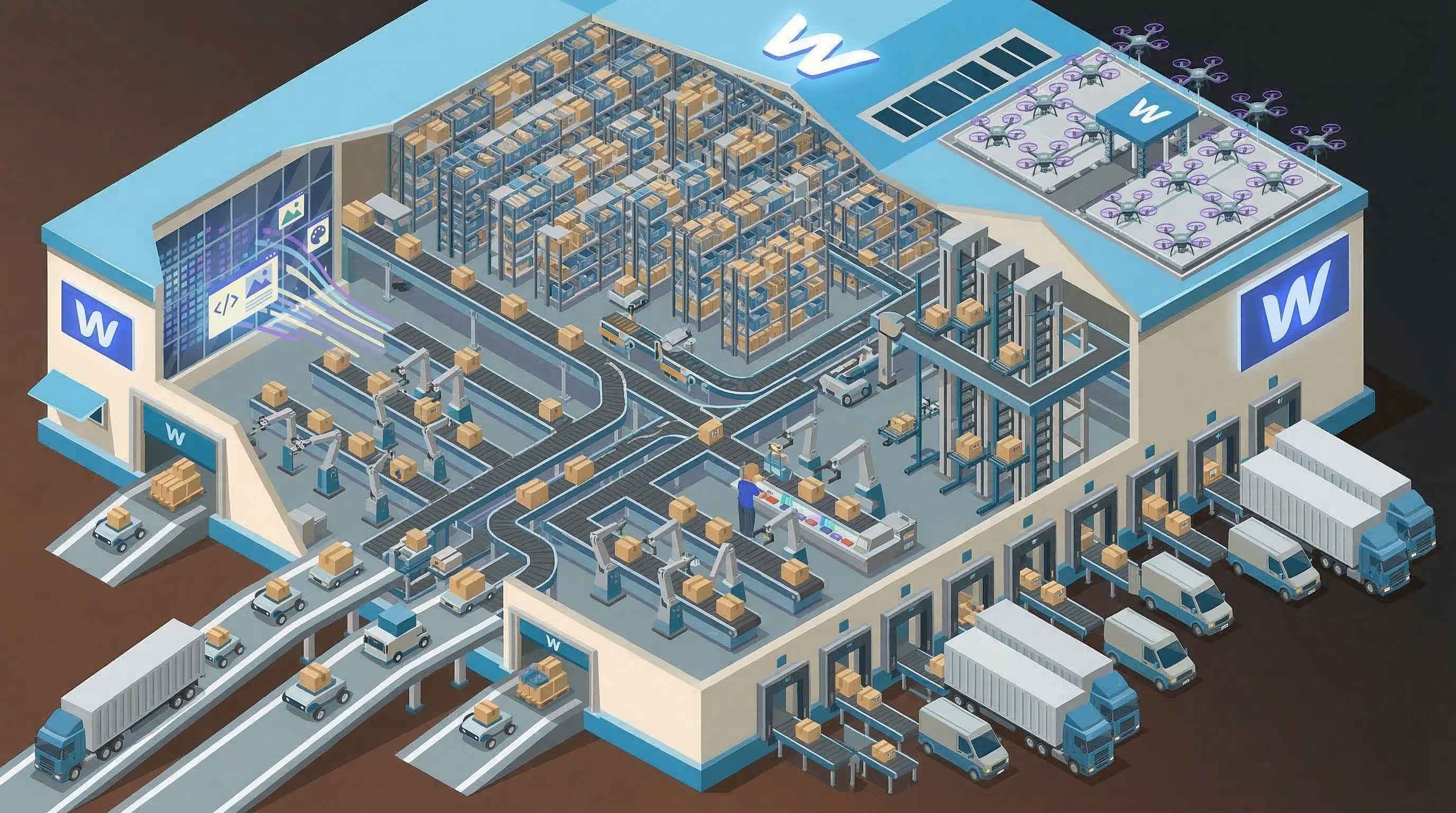


What once felt simple can quickly turn into a logistical challenge.
If your online store is built on Webflow, you might be wondering whether the platform can handle large-scale ecommerce operations.
Common questions include:
- Can Webflow support hundreds or thousands of orders per day?
- Is Webflow suitable for scaling ecommerce brands?
- How do Webflow stores manage fulfillment at high volume?
The short answer is that Webflow can absolutely support high-volume ecommerce businesses, but not entirely on its own. Most successful Webflow stores rely on external systems for logistics, fulfillment, and inventory management while using Webflow as the storefront.
In this guide, we’ll explore how Webflow fits into a scalable ecommerce stack, what its limitations are, and how growing brands handle fulfillment when order volume starts to increase.
Understanding High-Volume Ecommerce Fulfillment
Before looking at Webflow specifically, it helps to define what “high-volume” fulfillment actually means.
While the exact threshold varies by business, ecommerce stores typically enter high-volume territory when they begin shipping:
- 100+ orders per day
- hundreds of orders during peak campaigns
- thousands of orders per week
At this stage, fulfillment becomes an operational system rather than a manual process.
High-volume ecommerce fulfillment typically requires:
- Automated order routing
- Warehouse inventory management
- Shipping label generation
- Carrier integrations
- Tracking synchronization
- Returns processing
Without automation, managing these tasks manually quickly becomes inefficient and error-prone.
What Webflow Does Well for Ecommerce
Webflow was originally built as a design-focused website builder, giving developers and designers control over layout, CMS structure, and user experience.
Because of this, Webflow excels at the front-end experience of ecommerce.
Webflow allows businesses to:
- Create highly customized storefronts
- Manage product catalogs
- Accept payments online
- Capture customer information
- Manage order records
For many direct-to-consumer brands, Webflow provides far more design flexibility than traditional ecommerce platforms.
This makes it particularly popular among:
- Design-driven brands
- Marketing-focused ecommerce companies
- Startups launching new products
- Businesses that prioritize storytelling and branding
However, fulfillment operations are only one part of the ecommerce stack.
The Role of the Storefront vs Fulfillment Systems
To understand whether Webflow can support high-volume fulfillment, it’s important to separate two different systems:
The storefront
The customer-facing website where products are displayed and orders are placed.
The fulfillment infrastructure
The operational backend that stores inventory, packs orders, and ships products.
Webflow primarily operates as the storefront layer.
This means Webflow’s role in high-volume ecommerce is typically limited to:
- Displaying products
- Collecting payments
- Creating order records
The actual fulfillment process is usually handled by specialized logistics systems.
This architecture is increasingly common in modern ecommerce.
Why High-Volume Fulfillment Requires Specialized Infrastructure
Shipping a few orders per day is relatively straightforward. But as order volume grows, logistics becomes much more complex.
High-volume ecommerce operations must manage:
- Inventory stored across multiple locations
- Shipping carriers and delivery networks
- Packaging workflows
- Order batching and routing
- International shipments
- Returns and exchanges
These processes require warehouse management systems and fulfillment networks designed specifically for logistics.
Most website builders, including Webflow, are not designed to handle these operational layers internally.
Instead, they integrate with systems that do.
How Webflow Stores Handle High-Volume Fulfillment
Many growing ecommerce brands using Webflow adopt a composable commerce approach, where different tools handle different parts of the business.
In a typical setup:
- Webflow powers the storefront
- Payment processors handle transactions
- Automation tools handle workflows
- Fulfillment providers handle shipping
This modular architecture allows businesses to scale operations without replacing their storefront.
Fulfillment Option 1: Third-Party Logistics Providers
One of the most common solutions for scaling fulfillment is working with a third-party logistics provider (3PL).
3PL companies operate warehouses where ecommerce brands can store inventory.
When an order is placed on a Webflow store:
- The order is automatically sent to the warehouse.
- The warehouse picks and packs the items.
- A shipping label is generated.
- The order is shipped to the customer.
- Tracking information is returned to the store.
This allows ecommerce businesses to outsource fulfillment entirely.
3PL providers specialize in:
- Warehouse storage
- Packaging operations
- Carrier integrations
- International shipping
- Returns processing
For brands experiencing rapid growth, a 3PL can dramatically reduce operational workload.
Fulfillment Option 2: Amazon Multi-Channel Fulfillment
Another popular solution for scaling ecommerce fulfillment is Amazon Multi-Channel Fulfillment.
MCF allows ecommerce brands to store inventory in the same warehouse network used by Fulfillment by Amazon.
Unlike traditional FBA, which is primarily designed for Amazon marketplace orders, MCF can fulfill orders from any sales channel, including Webflow stores.
This means Webflow businesses can leverage Amazon’s global logistics infrastructure without selling exclusively on Amazon.
When a customer places an order on a Webflow store:
- The order is sent to Amazon’s fulfillment system.
- Amazon picks and packs the products.
- Amazon ships the order to the customer.
- Tracking information is returned to the store.
Because Amazon operates one of the largest logistics networks in the world, this approach can support extremely high order volumes.
For some ecommerce brands, this provides an easier scaling path than building relationships with multiple warehouse providers.
Automation Is the Key to Scaling
Regardless of which fulfillment provider is used, automation is essential for handling high order volumes.
Without automation, teams would need to manually:
- Export orders
- Send them to warehouses
- Create shipping labels
- Update tracking information
- Reconcile inventory
Automation systems eliminate these repetitive tasks.
Typical automation workflows include:
- Automatic order forwarding
- Inventory synchronization
- Shipping confirmation updates
- Tracking number delivery
- Customer notification emails
These processes allow ecommerce businesses to handle thousands of orders without manual intervention.
Inventory Management at Scale
One of the biggest challenges in high-volume ecommerce is inventory management.
When order volume increases, businesses must carefully track:
- Stock levels
- Product availability
- Warehouse distribution
- Incoming inventory shipments
If inventory data becomes inaccurate, businesses risk:
- Overselling products
- Delaying shipments
- Disappointing customers
Many fulfillment providers maintain centralized inventory systems that synchronize with ecommerce storefronts like Webflow.
This ensures that inventory levels stay updated automatically.
Shipping Speed and Customer Expectations
As ecommerce competition grows, customer expectations around delivery speed continue to increase.
Many shoppers now expect:
- Fast shipping options
- Accurate delivery estimates
- Reliable tracking updates
Fulfillment infrastructure plays a major role in meeting these expectations.
Large fulfillment networks can ship orders from warehouses closer to customers, reducing transit times.
For ecommerce brands operating on Webflow, integrating with scalable fulfillment providers allows them to offer competitive shipping speeds without operating their own warehouses.
When Webflow Stores Start to Struggle with Manual Fulfillment
Manual fulfillment works well in the early stages of an ecommerce business, but it rarely scales indefinitely.
Common warning signs that a business needs fulfillment automation include:
- Order volumes exceeding 30–50 orders per day
- Increasing shipping errors
- Staff spending large amounts of time packing orders
- Delayed shipping times
- Difficulty managing inventory
At this point, relying on manual processes often becomes a bottleneck.
Integrating automated fulfillment systems can dramatically improve operational efficiency.
Advantages of Using Webflow in a Scalable Ecommerce Stack
Despite its limited native logistics capabilities, Webflow still offers several advantages for ecommerce brands.
Complete Design Control
Webflow allows businesses to create fully customized ecommerce experiences.
Brands can design unique product pages, landing pages, and marketing content without relying on rigid templates.
Strong Content and Marketing Capabilities
Webflow includes powerful CMS and content management tools.
This allows brands to publish articles, guides, and product storytelling content that drives organic traffic and supports marketing campaigns.
Flexibility with External Tools
Because Webflow integrates with external systems through APIs and automation tools, businesses can connect it with:
- Fulfillment providers
- Inventory systems
- Marketing platforms
- Analytics tools
This flexibility allows ecommerce companies to build a scalable technology stack.
The Composable Commerce Model
Many modern ecommerce brands adopt what is often called composable commerce.
In this approach, the ecommerce stack is built using multiple specialized tools instead of relying on a single all-in-one platform.
For example:
- Webflow handles the storefront
- Payment gateways process transactions
- Automation platforms manage workflows
- Fulfillment providers handle logistics
- Analytics tools track performance
This modular architecture allows each part of the system to be optimized independently.
For high-growth ecommerce brands, this approach often provides more flexibility than traditional monolithic ecommerce platforms.
Is Webflow Suitable for High-Volume Ecommerce?
For businesses that rely heavily on design, branding, and marketing, Webflow can be an excellent storefront platform.
However, scaling ecommerce operations requires connecting Webflow to fulfillment systems designed for logistics.
When paired with automated fulfillment providers such as Amazon Multi-Channel Fulfillment or third-party logistics warehouses, Webflow stores can support extremely high order volumes.
The key is recognizing that Webflow is not meant to manage warehouse operations directly.
Instead, it serves as the customer-facing layer of a broader ecommerce infrastructure.
Final Thoughts
So, can Webflow handle high-volume ecommerce fulfillment?
Yes, but not by itself.
Webflow works best as the storefront and customer experience layer, while specialized fulfillment systems handle the operational side of ecommerce.
By integrating Webflow with automated logistics providers such as 3PL warehouses or Amazon Multi-Channel Fulfillment, ecommerce brands can build a scalable infrastructure capable of handling thousands of orders.
For businesses that want complete control over their storefront design while maintaining the ability to scale operations, this hybrid approach offers the best of both worlds.
With the right fulfillment strategy in place, Webflow can power ecommerce brands from their first sale all the way to large-scale order volumes.