
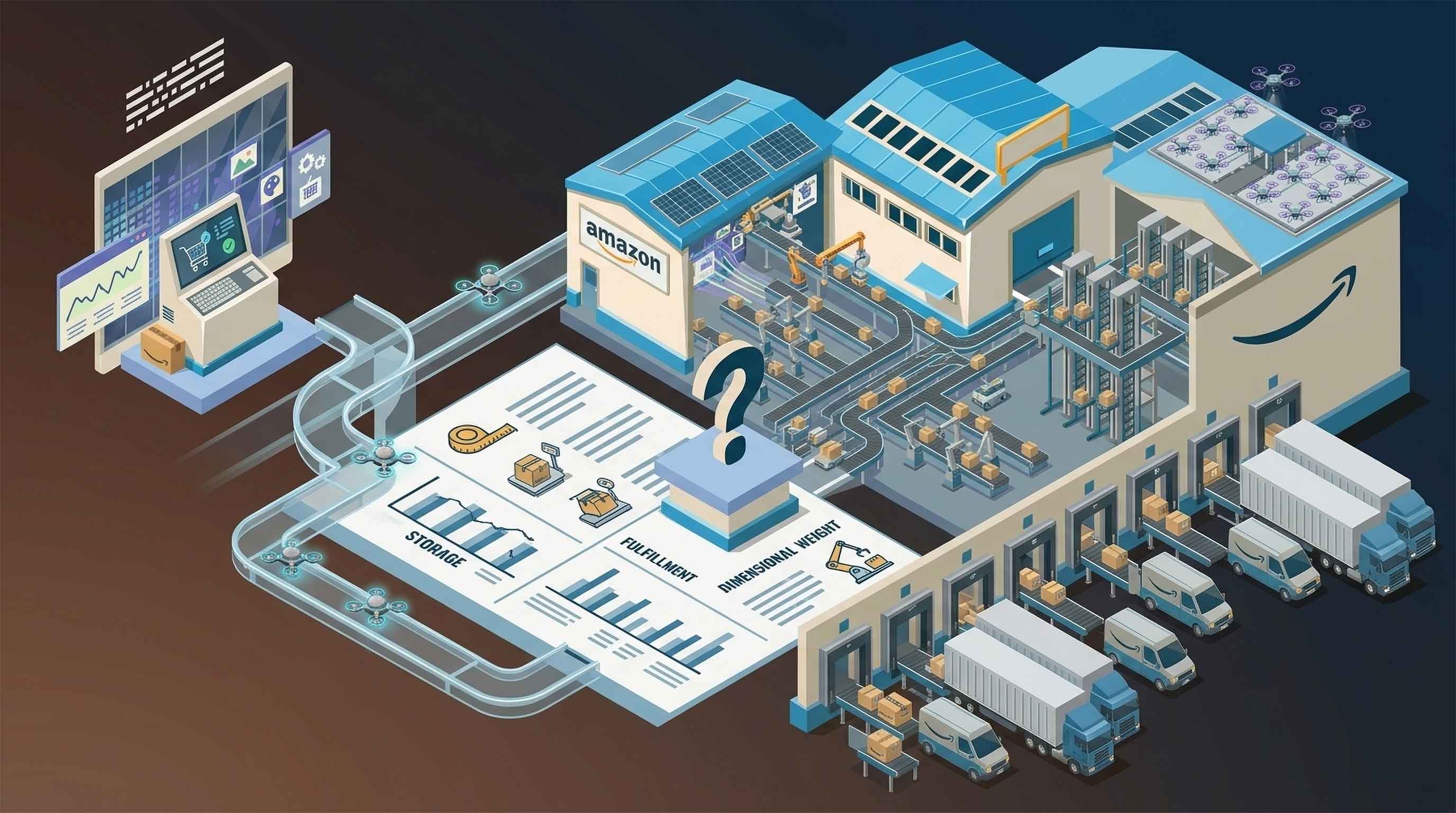


If you run a Webflow Ecommerce store and want to use Amazon’s fulfillment network to ship customer orders, Amazon Multi-Channel Fulfillment, usually called Amazon MCF, can be one of the most convenient options available.
MCF allows you to store inventory in Amazon fulfillment centers and use that inventory to fulfill orders from non-Amazon channels. That means a customer can place an order on your Webflow store, while Amazon handles the picking, packing, and shipping in the background.
For Webflow merchants, this solves a real operational problem. Webflow is excellent for building clean, flexible, high-converting ecommerce experiences, but it does not offer a native Amazon MCF fulfillment workflow out of the box. Without an integration, store owners often have to manually copy orders, export order data, or use complicated workarounds.
That is where MCF Connect helps. It connects Webflow Ecommerce orders to Amazon MCF, giving Webflow sellers a more automated way to fulfill orders through Amazon’s network.
But before using MCF, it is important to understand the costs.
Amazon MCF is not priced as one simple flat fee. Your total cost depends on the size and weight of the product, delivery speed, number of units in the order, storage time, returns, and any applicable surcharges. Amazon’s US MCF rate card states that fulfillment fees cover pick, pack, and ship services, and from May 2, 2026, Amazon applies a 3.5% fuel and logistics-related surcharge to US MCF fulfillment fees.
That does not mean MCF is expensive by default. In many cases, it can be very cost-effective, especially for small, lightweight, fast-moving products. But it does mean you need to understand your numbers before setting product prices, shipping rates, or free shipping thresholds.
What Amazon MCF Fees Include
Amazon MCF fulfillment fees cover the core fulfillment process. That includes picking the item from Amazon inventory, packing it, and shipping it to your customer.
The fee depends on several factors:
- The product size tier
- The product shipping weight
- The delivery speed selected
- The number of units in the order
- Whether the order uses standard or expedited delivery
- Whether returns are processed through MCF
- Whether additional surcharges apply
This is why two Webflow stores using Amazon MCF can have very different fulfillment costs.
A store selling lightweight supplements, cosmetics, or accessories may have a much easier time making MCF work profitably than a store selling oversized, heavy, or low-margin products.
Before using MCF across your full catalog, it is worth reviewing each SKU individually. The right question is not simply, “Is Amazon MCF affordable?” The better question is, “Is Amazon MCF profitable for this product, at this price, with this shipping promise?”
Standard Delivery Fees
For most Webflow stores, standard delivery will be the default MCF option.
Amazon’s 2026 US MCF rate card lists standard delivery as 3 business days click-to-delivery. That makes it fast enough for most ecommerce customers, while usually being more affordable than expedited delivery.
For small standard-size products, Amazon’s 2026 US MCF standard delivery fees for a 1-unit order start at $7.34 for items up to 4 oz. The fee increases as the item gets heavier. Items over 4 oz up to 8 oz are listed at $7.51. Items over 8 oz up to 12 oz are listed at $8.17. Items over 12 oz up to 16 oz are listed at $8.66.
For large standard-size products, the 1-unit standard delivery fee starts at $7.56 for items up to 4 oz. It rises to $7.72 for items over 4 oz up to 8 oz, $8.61 for items over 8 oz up to 12 oz, and $8.93 for items over 12 oz up to 16 oz. For heavier large standard products, the fee continues to increase. Items over 1 lb up to 2 lb are listed at $10.64, while items over 2 lb up to 3 lb are listed at $11.75. For items over 3 lb up to 20 lb, Amazon lists a fee of $11.75 plus $0.70 for every pound above 3 lb.
These figures show why product size and weight matter so much. A few ounces may not seem like much, but moving into a higher weight tier can change your fulfillment cost.
For Webflow store owners, this is especially important when deciding whether to offer free shipping. If you sell lower-priced products, a $7–$10 fulfillment fee can take a large portion of your gross margin. In that case, you may need to set a minimum order value for free shipping or encourage customers to buy bundles.
Expedited Delivery Fees
Expedited delivery is the faster MCF option.
Amazon’s 2026 US MCF rate card lists expedited delivery as 2 business days click-to-delivery. This can be useful if your customers expect fast delivery or if you want to offer a premium shipping option at checkout.
The trade-off is cost.
For small standard-size products, Amazon’s 2026 US MCF expedited delivery fees for a 1-unit order start at $10.70 for items up to 4 oz. Items over 4 oz up to 8 oz are listed at $10.83. Items over 8 oz up to 12 oz are listed at $11.45. Items over 12 oz up to 16 oz are listed at $13.12.
For large standard-size products, expedited delivery starts at $10.88 for items up to 4 oz. Items over 4 oz up to 8 oz are listed at $11.59, while items over 8 oz up to 12 oz are listed at $11.81. Larger and heavier products continue to increase by size and weight tier.
Expedited delivery can be a great customer experience feature, but it should be used carefully.
For most Webflow stores, the best setup is to offer standard delivery as the default shipping method and expedited delivery as a paid upgrade. This gives customers choice without forcing your business to absorb the higher cost on every order.
Free expedited delivery can still make sense, but usually only when the order value is high enough to justify it. For example, a brand may offer free expedited shipping above $150 while offering standard shipping above $75.
Multi-Unit Orders Can Improve Fulfillment Economics
One detail that is easy to miss is that Amazon MCF fees can become more efficient when customers order multiple units together.
Amazon’s rate card includes separate pricing for 1-unit, 2-unit, 3-unit, and 4-or-more-unit orders. In many cases, the per-unit cost is lower when multiple items are fulfilled in the same order.
This is important for Webflow stores because it gives you a way to improve margin without changing fulfillment provider.
Instead of only trying to reduce shipping costs, you can increase the value of each shipment.
Practical ways to do this include:
- Creating product bundles
- Offering volume discounts
- Setting free shipping thresholds above your average order value
- Promoting complementary products on product pages
- Adding post-purchase upsells
- Encouraging customers to buy two or three units at once
For example, if a customer buys one $25 product, the fulfillment cost may feel high as a percentage of the order. But if that same customer buys three units, your fulfillment cost per unit may improve significantly.
This is why Amazon MCF works best when it is part of your wider ecommerce strategy, not just treated as a backend shipping tool.
Storage Fees
Amazon MCF also involves storage fees because your products are stored in Amazon fulfillment centers.
Amazon’s 2026 US MCF rate card lists monthly storage fees based on product type, size tier, time of year, and storage utilization. For non-dangerous goods, standard-size storage is listed at $0.78 per cubic foot from January to September and $2.40 per cubic foot from October to December. For non-dangerous goods that are small bulky, large bulky, or extra large, Amazon lists storage at $0.56 per cubic foot from January to September and $1.40 per cubic foot from October to December.
The seasonal increase from October to December is worth paying close attention to.
Q4 is usually the busiest ecommerce period of the year, but it is also the most expensive period for storage. If you send too much inventory into Amazon and it does not sell through quickly, your storage costs can increase.
For fast-moving products, this may not be a problem. For slow-moving or bulky products, it can quickly affect profitability.
A sensible approach is to forecast inventory carefully and avoid sending excessive quantities of slow-moving stock into Amazon fulfillment centers before Q4.
Return Processing Fees
Returns are another cost to factor into your MCF model.
Amazon’s 2026 US MCF rate card includes return processing fees based on product size and weight. For small standard-size items, return processing starts at $3.22 for items up to 4 oz. It increases to $3.35 for items over 4 oz up to 8 oz, $3.45 for items over 8 oz up to 12 oz, and $3.55 for items over 12 oz up to 16 oz.
For larger standard-size products, return fees continue to increase with weight. For example, a large standard item over 1 lb up to 2 lb has a listed return processing fee of $4.70, while a large standard item over 2 lb up to 3 lb has a listed return processing fee of $5.60.
Returns are easy to overlook, especially if you are focused on outbound fulfillment fees. But for categories with higher return rates, they matter.
If you sell apparel, footwear, accessories, electronics, or products that customers often exchange, return costs should be included in your margin calculations from the start.
The 3.5% Fuel and Logistics-Related Surcharge
From May 2, 2026, Amazon applies a 3.5% fuel and logistics-related surcharge to US MCF fulfillment fees. Amazon says this surcharge is being applied because elevated fuel and logistics costs have increased operating expenses across the industry.
This surcharge applies to the fulfillment fee, not your product price.
For example, if your MCF fulfillment fee is $8.00, the surcharge would add $0.28. That would bring the fulfillment cost to $8.28 before considering any other applicable costs.
That may not sound like much on a single order. But at volume, it adds up.
If you fulfill 2,000 orders per month and the average surcharge is $0.30 per order, that is $600 per month in additional cost.
For Webflow merchants, this is exactly why it is important to review fulfillment economics regularly. Small changes in fulfillment cost can have a large effect when multiplied across every order.
How Webflow Stores Should Set Shipping Rates
Once you understand your MCF costs, you can decide what customers should pay for shipping at checkout.
Most Webflow stores use one of three approaches.
The first is flat-rate shipping. This is simple for customers and easy to communicate. You might charge $5.99 or $7.99 for standard shipping. The downside is that some orders will cost more to fulfill than the customer pays.
The second is free shipping above a threshold. This is often the best option for DTC brands. For example, you might offer free shipping on orders over $75. This encourages customers to add more to their cart and helps offset fulfillment costs through a higher average order value.
The third is paid expedited shipping. Standard shipping can be free or low-cost, while expedited shipping is offered as a premium option. This works well because customers who value speed can pay for it, while your business avoids absorbing expedited fees on every order.
The best setup depends on your product margins, average order value, and customer expectations.
Final Thoughts
Amazon MCF can be a strong fulfillment option for Webflow stores, especially if you sell small, lightweight, fast-moving products and want access to Amazon’s fulfillment network without moving your store to another platform.
But the numbers matter.
In 2026, Webflow merchants using MCF need to consider fulfillment fees, delivery speed, product size, product weight, storage fees, return fees, multi-unit pricing, and the 3.5% fuel and logistics-related surcharge.
The best approach is to calculate fulfillment cost by SKU, then build your shipping strategy around real numbers.
When connected properly through MCF Connect, Amazon MCF can remove a lot of manual work from your Webflow operations. But the brands that benefit most are the ones that treat fulfillment as part of their pricing and margin strategy, not just a task to automate.