
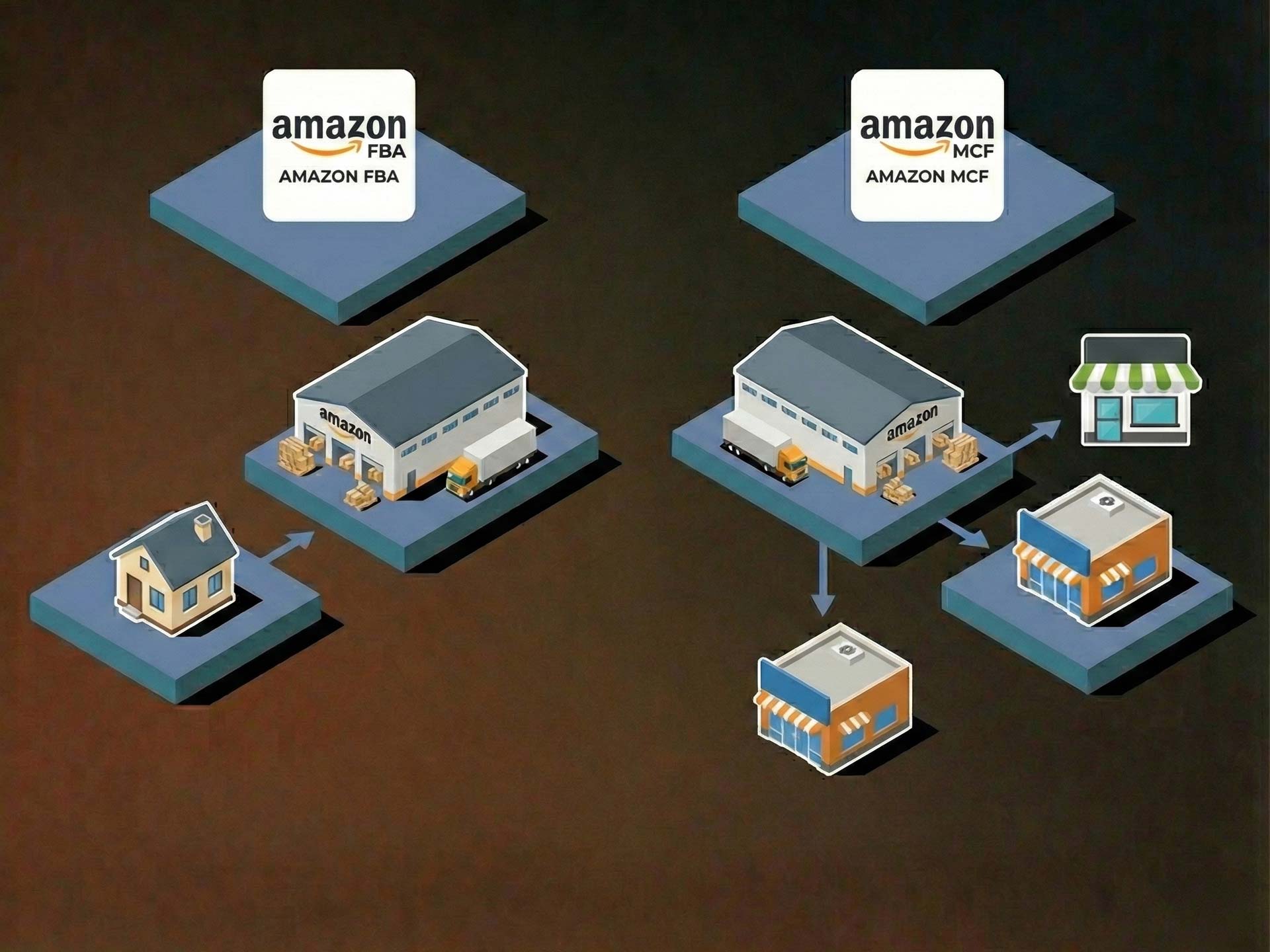


Amazon MCF and Amazon FBA are not the same.
Understanding the difference between Amazon FBA vs Amazon MCF is critical because choosing the wrong model can limit your growth, inflate your costs, or lock you too tightly into one ecosystem. This guide breaks down exactly how each works, where they overlap, and when to use one over the other.
What Is Amazon FBA?
Fulfillment by Amazon (FBA) is Amazon’s core logistics program designed specifically for sellers who sell on Amazon’s marketplace.
With FBA, you send your inventory into Amazon’s fulfillment network, and Amazon handles:
- Warehousing
- Picking and packing orders
- Shipping to customers
- Customer service
- Returns processing
- Prime eligibility
FBA is tightly integrated into Amazon’s retail experience. It is built to make marketplace selling faster, easier, and more scalable.
In short:
FBA is designed to help you win on Amazon.
What Is Amazon Multi-Channel Fulfillment (MCF)?
Amazon Multi-Channel Fulfillment (MCF) uses the same physical infrastructure as FBA, but with a completely different purpose.
MCF allows you to use Amazon’s warehouses to fulfill orders placed outside Amazon, including:
- Your Shopify or WooCommerce store
- Other marketplaces like eBay or Walmart
- Social commerce channels
- Direct B2B orders
Amazon becomes a backend logistics provider rather than just a marketplace partner.
In short:
MCF lets you use Amazon’s logistics without relying on Amazon for sales.
The Core Difference Between Amazon FBA and Amazon MCF
The simplest way to understand the distinction is this:
- FBA is marketplace fulfillment.
- MCF is omnichannel fulfillment.
FBA exists to support Amazon’s retail engine.
MCF exists to extend Amazon’s logistics into your broader ecommerce ecosystem.
They share infrastructure, but they serve very different strategic goals.
How Amazon FBA Works
The FBA workflow is deeply embedded into Amazon’s selling environment.
Step 1: Send Inventory to Amazon
You ship bulk inventory to Amazon fulfillment centers. Amazon distributes it across its network for fast delivery.
Step 2: List Products on Amazon
Your products appear as Amazon listings and often become Prime-eligible.
Step 3: Amazon Handles Fulfillment Automatically
When a customer buys:
- Amazon picks the item
- Packs it in Amazon-branded packaging
- Ships with Prime speed
- Manages support and returns
You don’t interact with the customer operationally.
How Amazon MCF Works
MCF looks similar operationally, but the trigger for fulfillment is completely different.
Step 1: Store Inventory in Amazon Warehouses
You still send inventory into Amazon’s network, just like FBA.
Step 2: Connect External Sales Channels
Your ecommerce platform integrates with Amazon so orders flow into the system.
Step 3: Amazon Ships Orders to Your Customers
When someone buys from your website (not Amazon), Amazon fulfills the order on your behalf.
You remain the merchant of record, not Amazon.
Who Controls the Customer Relationship?
This is one of the biggest differences between Amazon FBA vs Amazon MCF.
With FBA:
Amazon owns the customer relationship.
You do not receive full customer data.
You cannot control the packaging experience.
Amazon dictates communication standards.
With MCF:
You own the customer.
You control branding, acquisition, and lifecycle marketing.
Amazon simply executes the logistics.
This distinction has major implications for long-term brand building.
Branding and Packaging Differences
FBA orders are shipped in Amazon packaging, reinforcing Amazon’s brand - not yours.
MCF orders can be shipped in more neutral packaging, allowing you to maintain a branded experience (though customization options are still limited compared to independent 3PLs).
If brand perception matters, this difference becomes important quickly.
Sales Channel Flexibility
FBA is optimized for one channel: Amazon.
MCF supports many:
- Direct-to-consumer websites
- Subscription models
- Wholesale fulfillment
- Marketplace diversification
Businesses pursuing omnichannel growth typically need something beyond FBA alone.
Delivery Speed Prioritization
Amazon prioritizes FBA marketplace orders because they directly impact the Amazon customer experience.
MCF orders are fulfilled using the same network, but they are not always given the same priority during peak demand periods.
That means fulfillment performance can differ even though the infrastructure is shared.
Fee Structure: Why Costs Differ
Another key distinction in the Amazon FBA vs Amazon MCF comparison is how fees are structured.
FBA Fees Bundle Marketplace Economics
When you sell using FBA, your total cost includes:
- Referral fees (Amazon’s commission)
- Fulfillment fees
- Storage fees
- Optional advertising spend
FBA is tied to Amazon’s revenue model as a marketplace.
MCF Fees Are Pure Logistics Costs
MCF charges you strictly for fulfillment services:
- Pick and pack
- Shipping speed selection
- Storage
- Handling
You are not paying Amazon to generate the sale - only to fulfill it.
This changes how margins should be analyzed.
When Amazon FBA Is the Right Choice
FBA is ideal if your business strategy revolves around dominating Amazon as a sales channel.
It works best when:
- Amazon is your primary revenue source
- You want Prime eligibility to drive conversions
- You prefer Amazon managing customer service
- You don’t need strong brand differentiation
- You want the simplest operational setup possible
FBA excels at marketplace acceleration.
When Amazon MCF Makes More Sense
MCF becomes valuable when your business grows beyond Amazon.
It’s often used by brands that:
- Want to unify fulfillment across multiple channels
- Are investing in DTC growth
- Need operational scale without building warehouses
- Want to avoid splitting inventory across providers
- See logistics as infrastructure rather than strategy
MCF supports diversification rather than marketplace dependence.
Can You Use FBA and MCF Together?
Yes - and many sophisticated sellers do exactly that.
This hybrid approach allows you to:
- Use FBA to maximize Amazon sales performance
- Use MCF to fulfill off-Amazon orders from the same inventory pool
This avoids duplicating stock and simplifies inventory forecasting.
For many brands, this blended model offers the most operational efficiency.
The Strategic Tradeoff: Convenience vs Control
The real decision between Amazon FBA vs Amazon MCF is not about shipping.
It’s about how much control you want over your business.
FBA Maximizes Convenience
You outsource nearly everything.
Amazon handles operations end-to-end.
Growth is fast but platform-dependent.
MCF Provides Infrastructure Without Full Dependency
You still rely on Amazon physically, but strategically you remain channel-agnostic.
The distinction matters as businesses scale.
Limitations to Be Aware Of
Neither model is perfect.
FBA Limitations
- Marketplace dependency risk
- Limited brand ownership
- Strict compliance requirements
- Fee sensitivity
MCF Limitations
- Less customization than independent 3PLs
- Costs vary based on shipping choices
- International fulfillment can be complex
- Amazon still controls infrastructure access
Understanding these constraints prevents unpleasant surprises later.
A Real-World Example
Consider two ecommerce businesses:
Business A: Private-Label Product Seller
They generate 90% of sales through Amazon search traffic.
For them, FBA is ideal because:
- Prime eligibility drives conversion
- Amazon traffic fuels growth
- Operational simplicity outweighs brand control
Business B: Emerging DTC Brand
They sell through Shopify, social ads, and retail partnerships.
They choose MCF because:
- They need one fulfillment source for all channels
- They want to own customer relationships
- They want logistics scale without building it themselves
Same infrastructure. Different strategic use.
How to Decide Between Amazon FBA vs Amazon MCF
Ask yourself three questions:
1. Where Do You Want Growth to Come From?
If the answer is Amazon search, FBA is essential.
If the answer is multiple channels, MCF becomes more relevant.
2. Do You Want Customers to Belong to You or Amazon?
FBA leans toward Amazon ownership.
MCF lets you maintain more direct control.
3. Are You Building a Marketplace Business or a Brand?
Marketplace businesses optimize for velocity.
Brands optimize for longevity and independence.
Your fulfillment model should match that goal.
Common Misconception: MCF Replaces FBA
It doesn’t.
MCF is not an upgrade to FBA.
It is a different use case entirely.
Think of FBA as a sales accelerator and MCF as a logistics extension.
The Future of Fulfillment Is Omnichannel
Ecommerce is moving toward distributed commerce - brands selling everywhere customers exist.
That shift is why services like MCF exist.
Businesses increasingly need:
- One inventory pool
- Multiple sales channels
- Flexible fulfillment infrastructure
The debate is no longer FBA or MCF.
It’s how each fits into a broader system.
Final Thoughts: Which One Is Better?
Neither Amazon FBA nor Amazon MCF is universally better.
They solve different problems.
Choose FBA if your goal is to win inside Amazon’s ecosystem.
Choose MCF if your goal is to scale beyond it while leveraging Amazon’s logistics power.
The smartest businesses understand both, and deploy them intentionally.